
How Does State Code of Eligibility Work in JEE Main 2027 for Home State Quota?
What Is the State Code of Eligibility in JEE Main 2027?
The State Code of Eligibility is the state code assigned to a candidate based on the geographic location of the school or examination center from where they pass their Class 12 or equivalent qualifying examination. It is used by JoSAA to allocate 50% Home State Quota seats in National Institutes of Technology (NITs) and select GFTIs.
Official notices, free question papers aur chapter-wise weightage ke liye humara main JEE Main Guide dekhein.
Many students confuse physical domicile or permanent residential address with the State Code of Eligibility. It is crucial to note that NTA rules rely entirely on the location of your Class 12 board examination center, not your birth state or native address.
Class 12 Passing State vs Domicile State: Which One Matters for NIT Quota?
For JEE Main 2027 Home State Quota, only the Class 12 passing state matters. If a candidate natively belongs to Uttar Pradesh but completes Class 12 schooling from Kota (Rajasthan), their State Code of Eligibility will be Rajasthan. Consequently, they qualify for the 50% Home State quota at NIT Jaipur (MNIT), not NIT Allahabad (MNNIT).
The only exception applies to candidates completing Class 12 through NIOS (National Institute of Open Schooling) or distance education. For open school students, the State Code of Eligibility is determined by the state where their designated Study Centre is located.
How Does the 50% Home State vs 50% Other State Quota Work in NITs?
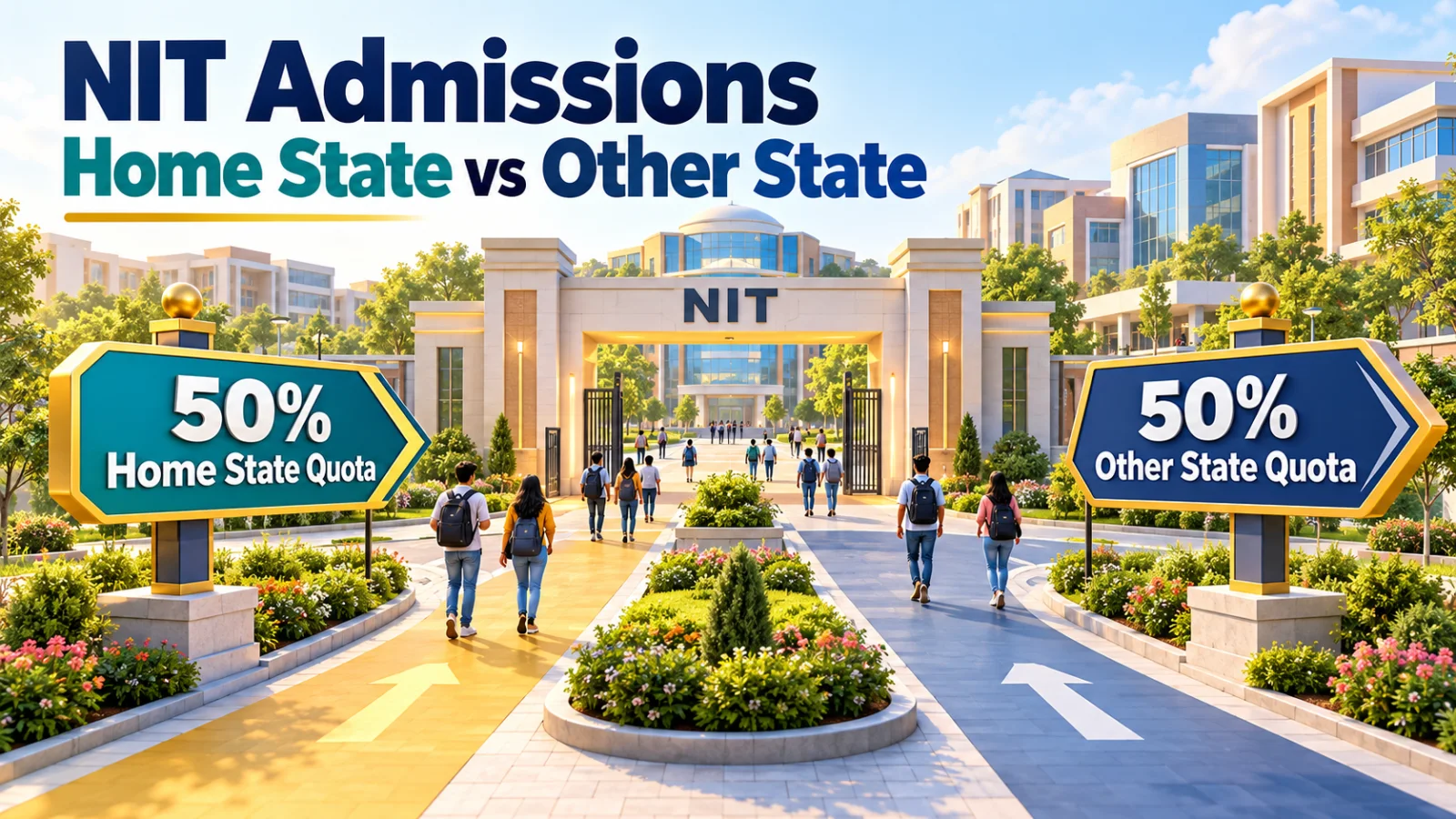
In all 31 NITs across India, total seats are split equally into two pools: 50% Home State (HS) Quota and 50% Other State (OS) Quota. Candidates whose State Code of Eligibility matches the location of the NIT compete under the Home State quota, while all other candidates compete under the Other State quota.
In top-tier NITs like NIT Trichy, NIT Surathkal, and NIT Warangal, cutoff ranks for Home State candidates can differ significantly from Other State candidates depending on regional candidate volume and competition density.
Comparison Table: Home State vs Other State Quota Characteristics
The following table outlines the key operational differences between Home State and Other State quota allocations in JEE Main 2027:
| Feature ParameterHome State (HS) QuotaOther State (OS) Quota | ||
| Determining Factor | State where Class 12 exam was passed | Any state outside the Class 12 passing location |
| Seat Share in NITs | 50% of total sanctioned seat capacity | 50% of total sanctioned seat capacity |
| Cutoff Ranks | Generally relaxed closing ranks for state residents | Higher competition with stricter closing ranks |
| Applicability in IIITs | Generally not applicable (100% All India Quota) | 100% All India Quota across most IIITs |
| Special Case (Union Terr.) | Supernumerary seats created if no NIT exists | Standard All India Open seat allocation |
What Special Rules Apply for NIOS, Improvement, and Abroad Students?
Specific scenarios govern eligibility codes for students in non-traditional education pathways during JEE Main 2027:
- NIOS / Open Learning Candidates: Your State Code of Eligibility depends on the state where your study center is located.
- Improvement Exam Candidates: If you pass Class 12 from State A and appear for an improvement exam from State B, your original passing state (State A) remains your State Code of Eligibility.
- Indian Nationals Passing Class 12 Abroad: Candidates passing Class 12 from schools abroad (e.g., UAE, Nepal) have their State Code determined by their permanent address in India as per their passport.
- Delhi State Quota Note: Delhi candidates passing Class 12 from Delhi schools get 85% state quota benefits in DTU, NSUT, and IGDTUW via JAC Delhi, while getting HS quota for NIT Delhi in JoSAA.
Checklist for Filling State Code of Eligibility in JEE Application:
- Verify the state location listed on your Class 12 admit card and mark sheet.
- Do not confuse your permanent home address with your school's physical state.
- Double-check state codes during registration (e.g., DL for Delhi, UP for Uttar Pradesh, RJ for Rajasthan).
- Keep school leaving certificates handy for JoSAA document verification.
Frequently asked questions
If I live in Noida (UP) but completed Class 12 from a school in Delhi, what is my State Code of Eligibility for JEE Main 2027?
Your State Code of Eligibility will be Delhi (DL), because your Class 12 school is located in Delhi. You will be eligible for the Home State quota at NIT Delhi and JAC Delhi engineering colleges.
Is Home State Quota applicable in IIITs and GFTIs during JoSAA counselling?
Most Indian Institutes of Information Technology (IIITs) fill 100% seats on an All India Quota basis. However, a few specific GFTIs and select state-funded institutes reserve seats for state candidates.
What state code should I choose if I completed Class 12 from NIOS?
If you completed Class 12 from NIOS, your State Code of Eligibility is determined by the state where your NIOS study center is located.
Aur padhein
 Cutoffs JEE Main 2027 Marks vs Percentile: What Score Is Safe for Top NITs and IIITs?
JEE Main 2027 is a major entrance examination for engineering aspirants in India. This guide explains what students can…
2 Nov 2026 · 6 min read
 Guidance Who Is Eligible for JEE Main 2027? Age Limit, Class 12 Rules and Attempts
JEE Main 2027 is a major entrance examination for engineering aspirants in India. This guide explains what students can…
2 Nov 2026 · 7 min read
 Strategy How to Prepare for JEE Main 2027 in 90 Days? Important Chapters and Timetable
JEE Main 2027 is a major entrance examination for engineering aspirants in India. This guide explains what students can…
2 Nov 2026 · 7 min read